


Guitar is an incredibly versatile instrument, and mastering the minor pentatonic scale can take your playing to the next level. In this post, I will guide you through the basics of using this scale for crafting memorable solos. You will learn how to navigate the fretboard, as well as tips for improvising and incorporating expressive techniques. By the end of this guide, you will feel confident enough to create your own unique guitar solos that highlight the melodic richness of the minor pentatonic scale.
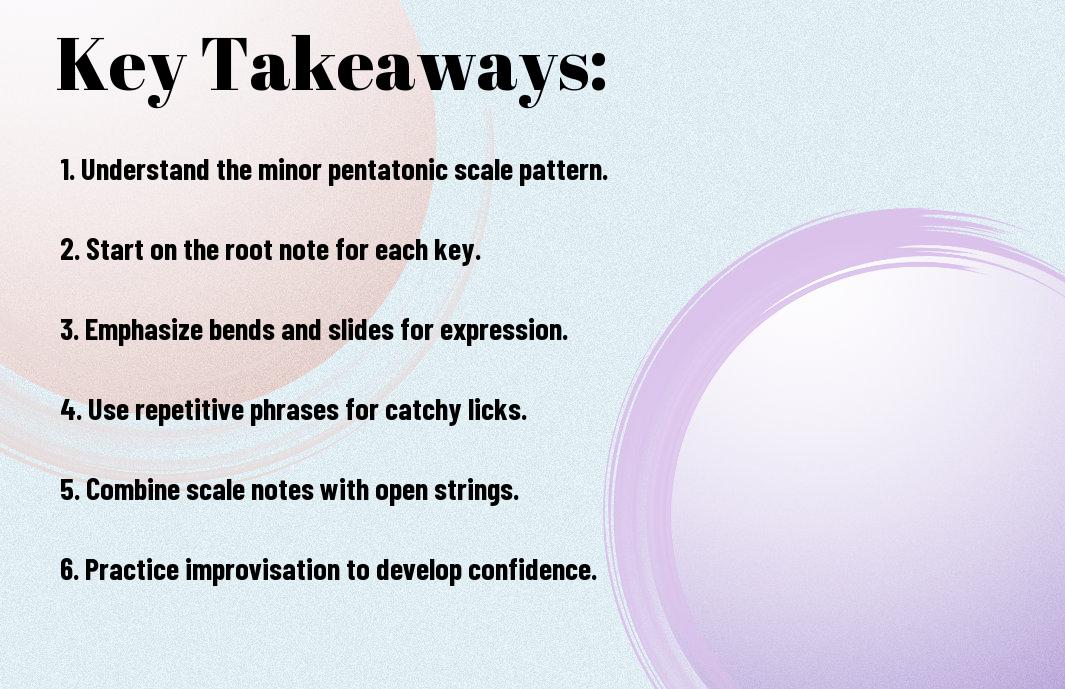

Understanding the Minor Pentatonic Scale
A fundamental aspect of playing expressive guitar solos is grasping the minor pentatonic scale. This scale is widely used across various music genres, including rock, blues, and jazz. By learning this five-note scale, you can create memorable solos that capture emotion and help to convey your musical ideas effectively. It serves as a versatile tool in your guitar playing toolkit, allowing you to improvise and enhance your playing style.
Scale Construction
The minor pentatonic scale is constructed from five specific notes: the root, minor third, fourth, fifth, and minor seventh of the corresponding major scale. For example, in the A minor pentatonic scale, the notes are A, C, D, E, and G. This simple structure enables you to easily find and utilize these tones when crafting your solos.
Importance in Guitar Solos
After familiarizing yourself with the minor pentatonic scale, you’ll quickly see its significance in creating guitar solos. The scale’s unique quality allows you to blend seamlessly with various musical contexts and express yourself more freely. Solos built around this scale often resonate with listeners, adding depth and emotion to your performances.
But it doesn’t stop there. The beauty of the minor pentatonic scale lies in its adaptability; it can be combined with other scales and techniques to create intricate musical ideas. You can bend notes, use slides, and add vibrato to elevate your solos. So, as you explore this scale, experiment with different techniques to discover your unique sound and style, ultimately enhancing your guitar playing. I assure you, mastering this scale opens up numerous avenues for creativity and expression in your solos.
Basic Techniques for Playing Solos
It is crucial to master a few foundational techniques to make your guitar solos shine. These techniques will allow you to express emotions and add flair to your playing, enhancing your overall musicality. You’ll want to focus on bending notes, using hammer-ons and pull-offs, and establishing a good sense of timing. By incorporating these elements, you’ll create solos that are not only technically impressive but also resonate deeply with your audience.
Bending Notes
For bending notes, you alter the pitch of a note by pushing or pulling the string, creating a more expressive sound. This technique allows you to emulate the nuances of singing or vocal inflections, lending emotion to your solos. I often use bends at the end of phrases to create tension and anticipation. Practicing different bends across the fretboard will help you find your unique voice as a guitarist.
Hammer-Ons and Pull-Offs
Beside bending notes, hammer-ons and pull-offs are key techniques that add fluidity to your playing. These techniques allow you to play several notes in quick succession without picking each one, contributing to a smooth and connected sound. They’re fantastic tools for executing faster phrases while maintaining clarity.
Plus, incorporating hammer-ons and pull-offs allows you to save energy and makes your playing more efficient. For example, I often use a hammer-on from the root note to the minor third in a minor pentatonic scale, creating a compelling lick. Similarly, pull-offs can effectively lead into other notes, creating a seamless flow. Experiment with these techniques to discover a range of expressive possibilities within your solos.

Common Finger Positions and Patterns
Despite the endless variety in guitar playing, mastering common finger positions and patterns is necessary for creating smooth and recognizable solos. These patterns not only help you navigate the minor pentatonic scale but also provide a foundation for improvisation. Understanding where to place your fingers and how to transition between these shapes will significantly enhance your ability to play solos quickly and fluidly.
First Position Fingerings
Along with the basics of the minor pentatonic scale, you’ll want to focus on first position fingerings. This involves familiarizing yourself with the specific finger placements on the fretboard for the scale’s notes. Practicing these fingerings will make it easier for you to access the notes when you’re developing your solos, laying the groundwork for more complex techniques down the line.
Movable Patterns
After you get a grasp of the first position fingerings, I recommend exploring movable patterns. These allow you to shift the same fingerings across the fretboard, enabling you to play the minor pentatonic scale in different keys. This flexibility not only expands your soloing capabilities but also enhances your songwriting versatility, giving you a solid framework to construct creative phrases.
Position your fingers on the fretboard based on the scale’s root note, and use the same fingering pattern up and down the strings. Each position can be moved up or down, corresponding with different root notes. This means that once you learn a pattern, you can transpose your solos anywhere on the neck. By practicing these movable patterns, I found that my improvisational skills improved tremendously, allowing me to navigate through various tonalities effortlessly.
Combining Techniques for Expressive Solos
Keep in mind that combining various techniques will elevate your solos to a whole new level. By incorporating elements such as bends, slides, and hammer-ons with the minor pentatonic scale, you can create a unique sound. For some inspiration, check out these Easy Minor Pentatonic Solos to Learn, which highlight how expressive these simple techniques can be.
Rhythm and Timing
Across different styles, rhythm and timing are vital in making your solos stand out. I often experiment with syncopation and varying note durations to create rhythmic interest. Playing around with these elements not only adds texture but also helps to convey emotions within your solos.
Adding Vibrato
Around bends and sustained notes, vibrato can add a layer of expressiveness that captivates the listener. It’s a fantastic way to infuse your personality into a solo, making each note resonate. Practicing vibrato will not only enhance your playing but also allow you to communicate more effectively through your instrument.
Techniques for adding vibrato can vary, but generally, I use a combination of finger movement and wrist motion to achieve a smooth, controlled wobble. Explore different speeds and widths of vibrato to find what best suits your style. By integrating this technique into your solos, you can turn simple notes into heartfelt expressions, captivating your audience with every phrase.
Learning from the Masters
To truly understand the power of the minor pentatonic scale in guitar solos, I suggest looking at how legendary guitarists have employed it. Their unique approaches and expressions often highlight the scale’s versatility. By studying their techniques, you can incorporate their influences into your own playing, enriching your solos and enhancing your musicality.
Influential Guitarists Utilizing the Scale
Any guitarist can acknowledge the massive impact of artists like Jimi Hendrix, B.B. King, and Eric Clapton. These musicians have made the minor pentatonic scale a foundational element of their solos, showcasing its emotional depth and technical prowess. By learning their styles, you can expand your own skill set.
Analyzing Famous Solos
Across various genres, iconic solos often feature the minor pentatonic scale as a key component. As you look into famous tracks, you’ll notice patterns and stylistic choices that can enhance your own improvisation and solo creation.
Understanding these famous solos can unlock numerous techniques for your playing. By breaking them down, I’ve found that they often incorporate bends, slides, and vibrato, all using notes from the minor pentatonic scale. Listen closely to the expressions and nuances, and try to emulate them in your practice sessions. Analyze how these artists transition between phrases and use rhythmic variation, and you’ll start to develop your own expressive voice inspired by the best in the business.

Practical Exercises for Mastery
After learning the minor pentatonic scale, it’s time to put that knowledge into practice. I recommend focusing on different exercises that can help you become proficient with the scale through repetition and application. Start with basic scale runs, then move to incorporating slides, bends, and hammer-ons. These techniques will not only enhance your speed but also your expressiveness when playing solos.
Scale Practice Routines
Along with improvisation, developing a solid scale practice routine is vital. I suggest dedicating a part of your daily practice to the minor pentatonic scale. Start with ascending and descending runs, then introduce rhythmic variations to keep it engaging. You can also try playing along with backing tracks in various genres to see how the scale fits within different contexts.
Improvisation Tips
One key aspect of improvisation is to familiarize yourself with the sounds of the minor pentatonic scale. Here are some tips to get you started:
- Experiment with different note combinations.
- Create phrases by repeating melodic motifs.
- Listen to your favorite guitar solos and try to replicate them.
- Use dynamics to add emotion to your playing.
The more you practice improvisation within the scale, the more confident you will become.
Considering how you can develop your improvisation skills, I suggest focusing on ear training and familiarizing yourself with the overall tonal landscape. Incorporate these techniques into your routine:
- Record yourself and evaluate your solos.
- Play along with other musicians to explore interactions.
- Challenge yourself with different tempos and styles.
- Stay open to spontaneity in your playing.
The journey of improvisation is all about exploration and growth.
To wrap up
Now that you’ve learned how to play basic guitar solos using the minor pentatonic scale, you can start experimenting and finding your unique sound. By practicing the scale and incorporating techniques like bending and sliding, I encourage you to explore your creativity. For additional guidance, check out this Guitar Lesson: Make the Minor Pentatonic Scale Work for You. With dedication and practice, you’ll be crafting impressive solos in no time!