


Over the years, I’ve discovered effective strategies for mastering the guitar, even with small hands. If you find yourself struggling to reach certain chords or feel limited by your hand size, you’re not alone. In this post, I’ll share practical tips and techniques that can help you adapt your playing style, choose the right guitar, and enhance your overall experience. Let’s unlock your potential and make guitar playing more enjoyable together!
Understanding the Challenges of Small Hands
To play guitar effectively with small hands, it’s important to recognize the unique challenges that come with it. Stretching fingers to reach certain frets can be difficult, and some chord shapes may seem out of reach. However, by understanding these challenges, you can develop strategies that work for you, allowing you to enjoy playing and improve your skills without frustration.
Fingering Techniques
Along your guitar journey, you will discover various fingering techniques that can help you navigate the fretboard more easily. Using the tips of your fingers can enhance your reach, while incorporating finger rolling can allow you to play chords efficiently. Focus on developing a fluid movement that suits your hand size, enabling you to play with greater comfort and control.
Chord Shapes and Modifications
Shapes play a significant role in your guitar playing experience. With smaller hands, traditional chord shapes might feel overwhelming, but various modifications can make playing easier. For instance, consider using barre chords sparingly, adopting simpler open chord shapes, or adjusting finger placements for a more comfortable fit. This not only promotes better technique but also enhances your overall playing experience, empowering you to express your musical creativity without limitations.
Choosing the Right Guitar
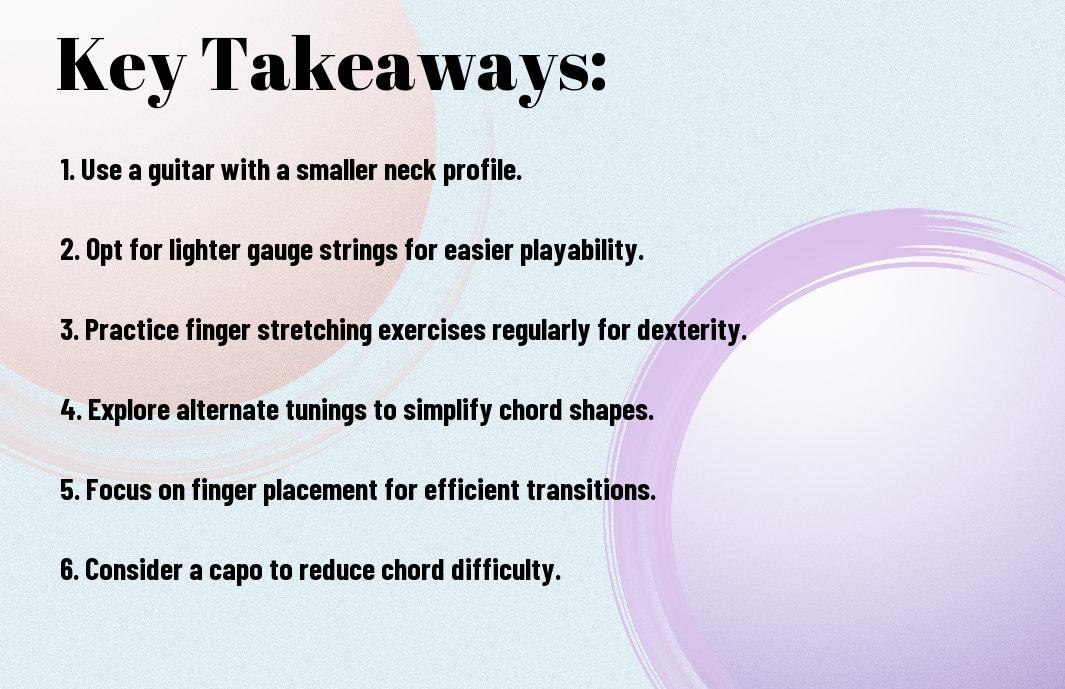
Even if you have small hands, selecting the right guitar can significantly enhance your playing experience. I suggest looking for models that offer smaller body sizes, comfortable shapes, and appropriate neck profiles. Acoustic or electric guitars with these characteristics can help you play more easily and enjoyably, allowing you to develop your skills without unnecessary frustration.
Body Size and Shape
At the outset, consider the body size and shape of the guitar you want to play. A smaller bodied guitar, such as a concert or smaller dreadnought, can be far more manageable for hands that may struggle with larger models. Opting for a guitar with contours that fit comfortably against your body can promote better posture and finger positioning.
Neck Profile and Fretboard Width
Below, let’s probe into neck profile and fretboard width, which play a significant role in your comfort. For smaller hands, I recommend guitars with a slim neck profile and narrower fretboards. This design allows for easier finger placement and stretching, helping you to form chords more efficiently and access notes further up the neck without straining your hands.
And when considering neck profiles, pay attention to the shape and thickness. A “C” shape neck often feels more comfortable under your fingers compared to thicker profiles. Additionally, a fretboard width of 1.6 to 1.7 inches can offer the space you need to maneuver your fingers without cramping. Trying out different combinations in a store can help you find the perfect fit for your playing style.

Effective Finger Placement
Once again, mastering effective finger placement on the guitar is vital for players with small hands. I find that positioning my fingers closer to the frets allows for more precise pressing with less stretch. Ensure your fingers arch enough to avoid muting adjacent strings, while also keeping your wrist relaxed. This technique can enhance sound clarity, making it easier to play chords and melodies without unnecessary strain.
Tips for Stretching and Strengthening
With consistent practice, I encourage you to incorporate specific exercises that focus on stretching and strengthening your fingers. Here are some tips to enhance your dexterity:
- Practice finger stretches daily.
- Use rubber bands to perform extension exercises.
- Incorporate finger push-ups for strength.
- Engage in slow finger exercises on the fretboard.
Perceiving these exercises as part of your routine can lead to significant improvements over time.
Utilizing Finger Independence
Placement of your fingers independently on the fretboard is a key skill in playing guitar. I encourage you to practice playing scales and arpeggios that require each finger to move distinctly, which will greatly enhance your finger independence. Experimenting with different fingerings allows for greater versatility in your playing while accommodating the limitations of smaller hands.
In addition to practicing scales, I recommend focusing on finger exercises that emphasize independence, such as the spider exercise, where you alternate fingers on different frets. This not only builds strength but also trains your brain to coordinate the movements of each finger separately. As you gain more control, you’ll find it easier to tackle complex chord shapes and intricate solos, ultimately enhancing your overall guitar playing experience.
Alternative Tunings
Not every song needs standard tuning, especially if you have small hands. Exploring alternative tunings can unlock a world of easier playability while also adding freshness to your sound. Tuning your guitar to open tunings or other unconventional setups can help you achieve chords and notes that feel more comfortable to fret, allowing for more creativity and less frustration.
Benefits of Open Tunings
Against conventional wisdom, open tunings provide unique opportunities for enhancing your playing. These tunings allow you to create rich, resonant chords without extensive finger stretching, making it easier to explore fingerstyle techniques or slide guitar. Additionally, they facilitate quick transitions between chords, which is particularly beneficial for those of us with smaller hands.
Easy Chord Alternatives
Along your guitar journey, you may discover that some chords can be substituted to make playing feel more manageable. Chords like G, C, and D can be simplified or altered to require fewer finger stretches. Focusing on these alternatives will not only help ease the strain on your fingers but also open the door to new sounds and playing styles.
Indeed, exploring easy chord alternatives can be a game-changer for your playing experience. You might find that using power chords or barre chord variations allows you to play songs more comfortably. These alternatives not only simplify finger placements but also lend themselves well to different genres. I encourage you to experiment with these variations so you can enjoy making music without the limitations that small hands might impose.

Practice Strategies
All guitarists, especially those with small hands, can benefit from tailored practice strategies. I encourage you to explore resources like this [Question] Any tips for guitar players with small hands?, which may provide valuable insights. Integrating specific techniques into your practice routine can help optimize your playing and make it more enjoyable.
Short, Focused Sessions
About my own experience, I’ve found that focusing on short, concentrated practice sessions works wonders for my playing. I typically set aside 20 to 30 minutes, which allows me to maintain my focus without feeling overwhelmed. This way, I can build my skills progressively while keeping my enthusiasm for the guitar alive.
Building Muscle Memory
One effective approach that I’ve adopted is focusing on building muscle memory. This entails repetition of chords and scales, which lets my fingers learn the movements they need to execute accurately over time.
Muscle memory is the foundation of fluent guitar playing. When I practice scales and chord shapes repeatedly, my fingers become more adept at moving quickly and accurately. By consistently working on these basic skills, I notice significant progress, enabling me to focus on creating melodies and expressing emotions through my playing. Take your time to incorporate simpler movements, allowing your hands to adapt naturally and gain confidence.

Resource Recommendations
Your journey to mastering the guitar with small hands can be supported by various resources. I recommend checking out these 10 Tips for Guitar Players with Small Hands for practical advice tailored to your needs. These resources offer insights that can enhance your playing experience and boost your confidence.
Online Tutorials and Apps
Between YouTube, which is filled with tutorials specifically designed for players with smaller hands, and apps that allow you to practice finger stretches and chord shapes, there are countless ways technology can assist you. I often find that these interactive tools help me grasp concepts more easily and keep me motivated to practice.
Books and Community Support
With a plethora of books available focused on guitar techniques for players with small hands, you can gain valuable insights and strategies. I highly suggest exploring into online forums and communities where fellow guitarists share tips, resources, and encouragement—this can be invaluable in your learning journey.
In fact, participating in a community can provide a sense of belonging and motivation. Engaging with others who face similar challenges can lead to sharing effective practice methods and even personal stories of overcoming obstacles. You may also discover recommended books that cater specifically to smaller-handed players, enriching your understanding of guitar techniques and enhancing your overall playing experience.
Conclusion
From above, I’ve shared practical tips for playing guitar with small hands, emphasizing techniques that can enhance your playing experience. By choosing the right guitar, adapting your finger placements, and practicing specific exercises, you can develop your skills effectively. You may find that with consistent practice and the right mindset, your hand size becomes less of a limitation and more of a unique strength in your musical journey. Embrace your individuality and enjoy the process of making music.